108 Mile Ranch Wildfire Risk Management Plan
Summary
- There is considerable risk that 108 Mile Ranch could be severely damaged by wildfire
- 108 Mile Ranch is inadequately prepared for this wildfire risk
- Other communities, such as Logan Lake BC, have demonstrated proactive measures that have protected their town from wildfire damage; Logan Lake is a FireSmart model that other communities can learn from
- 108 Mile Ranch should take proactive measures to reduce the risk of wildfire damage, including:
- Spreading awareness and knowledge of of FireSmartBC information and practices
- Establishing a formal Community Wildfire Resiliency Plan (CWRP) in accordance with FireSmartBC Instruction Guide
- Protecting properties by thinning trees and other actions in accordance with the FireSmartBC Home Ignition Zone
- Protecting properties by installing rooftop sprinklers similar to how Logan Lake BC does it
- Gain formal recognition by FireSmart BC as a FireSmart community
The Wildfire Risk in 108 Mile Ranch
108 Mile Ranch is densely packed with many tall trees.
In a scenario where there is an exceptionally hot and dry summer, this becomes a serious wildfire risk.
It is in the interest of all members of our community for our entire community to be protected.
For example, what good would it be, if a catastrophic wildfire struck 108 Mile Ranch, and only a minority of the homes were to survive, while the majority of the rest of the community were destroyed? The community itself would be gone; the minority of surviving homes would be without a community. The businesses and post office at the mall would most likely be closed down. The elementary school would be closed down.
Not only would this be very regrettable, but it would also likely greatly diminish the value of the surviving properties. After all, how much demand would there be to buy a property in 108 Mile Ranch if there was no longer a community, no functioning elementary school, no functioning mall, and no functioning post office?
Therefore, we all benefit together when our entire community is protected.
Property Value
According to the 2021 federal census data, there are about 1,155 "usually occupied" private residences (e.g. residences that are not vacation homes) in the 108 Mile Ranch area (which includes the 105 Mile Lake area).
According to realtor data, the typical market price of a house in 108 Mile Ranch is currently around $500K or more.
If a catastrophic wildfire burned through 108 Mile Ranch and destroyed the majority of the homes (e.g. 75%), that would be about $300M to $600M worth of damage.
FireSmart Home Ignition Zone
One of the simplest and most effective ways to protect our community is to advocate for home owners to learn about FireSmart practices for their home, so that they take proactive measures in reducing the risk.
FireSmart Canada has defined a Home Ignition Zone, which shows how home owners can minimize their home and property’s vulnerability to wildland fire by addressing threats in each of the three priority zones

- In the immediate area, remove vegetation and all combustible material.
- In the intermediate zone, use only non-combustible materials, remove all woody debris and combustible items, and relocate or protect trailers, RVs, and sheds with at least 1.5 m of non-combustible ground cover.
- In the extended zone, thin the evergreen trees to maintain at least 3 metres between single or grouped tree crowns, prune branches up to 2 metres from the ground, remove surface fuels regularly, and extend these practices beyond 30 metres in coordination with neighbours and forestry professionals.
Due to the type of trees in the 108 Mile Ranch area (e.g. douglas fir trees, white aspen trees), and the typical way in which they grow, there are many areas with densely packed trees, including many cases where they are close to homes within the ignition zone. With respect to the FireSmart recommendation that there be a distance of 3 metres between the crowns of trees, this means that many of the properties in 108 Mile Ranch would not currently be considered Fire Smart, and correcting this would require significant work in thinning the trees.
Starting with creating awareness of the FireSmart Home Ignition Zone would be an easy and effective first step towards making the community Fire Smart. For example:
- Create a simple poster using this infographic (or use the poster provided by FireSmart)
- The poster would carry more weight if it was clearly endorsed / signed off by the 108 Mile Ranch fire department
- Put a QR code and a web link on the poster that points to more FireSmart information
- Large copies of the poster could be placed in various high-volume areas, e.g. in the 108 Mall on the bulletin board, and other common community locations
- Smaller flyers (e.g. regular size sheet of paper) with this infographic could be given to the post office to be distributed in each mailbox
- Flyers with this infographic could be given to the elementary school to give to each student to bring home
A General Plan to Protect 108 Mile Ranch with The FireSmartBC RoadMap
To protect 108 Mile Ranch, we would implement a phased approach in accordance with The FireSmartBC Roadmap. This is a general overview of that roadmap.
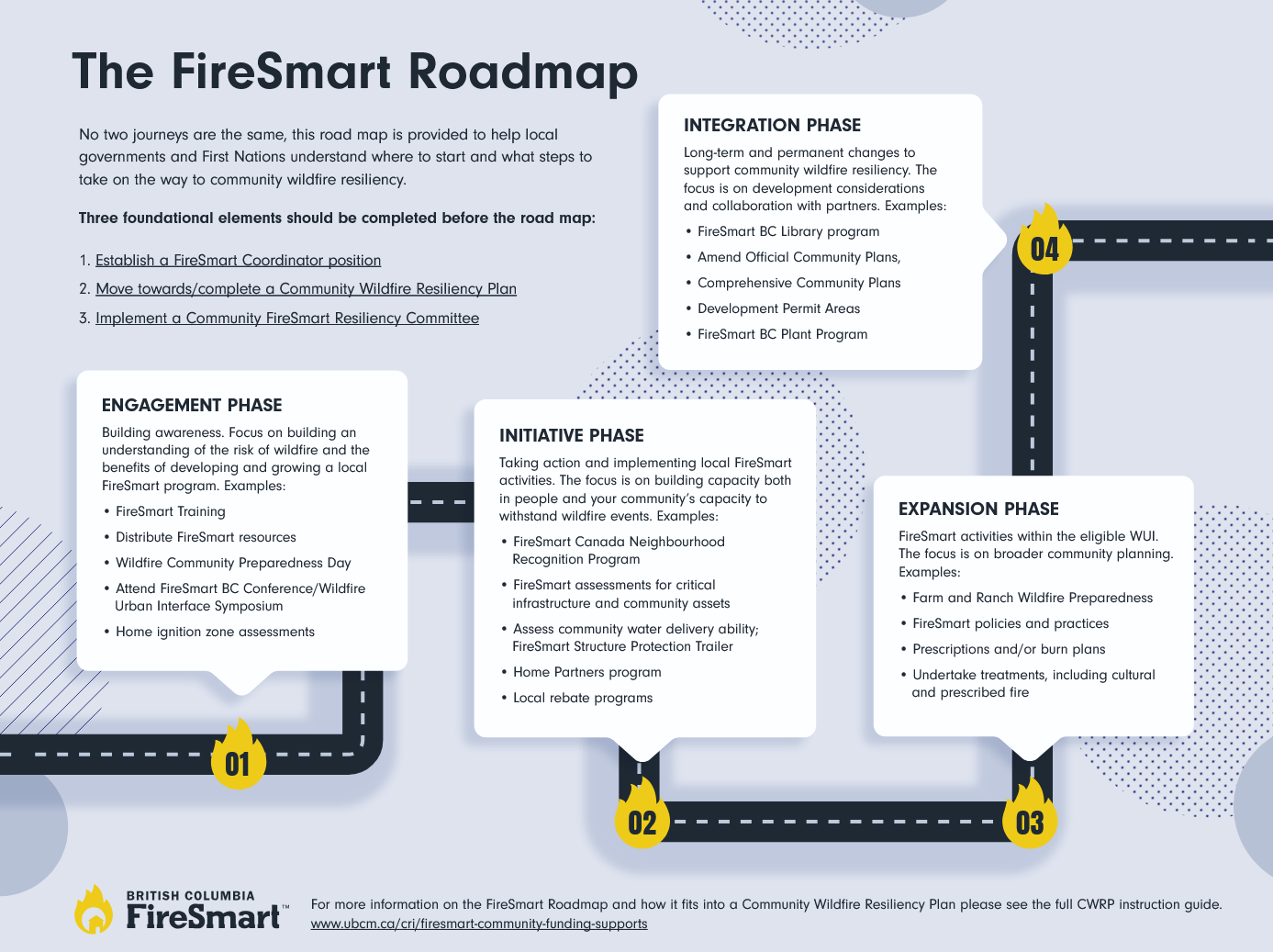
Three foundational elements should be completed before the road map:
- Establish a FireSmart Coordinator position
- Move towards/complete a Community Wildfire Resiliency Plan (CWRP)
Some existing CWRPs: - Implement a Community FireSmart Resiliency Committee
The Roadmap then describes 4 phases:
- Engagement Phase - Build awareness, focusing on understanding the risk of wildfire and the benefits of developing a local FireSmart program.
- Initiative Phase - Taking action and implementing local FireSmart activities, including gaining formal recognition by FireSmart BC as a FireSmart community
- Expansion Phase - The focus is on broader community planning including prescriptions and/or burn plans
- Integration Phase - Long-term and permanent changes to support community wildfire resiliency
The Logan Lake Approach
Logan Lake is a model FireSmart community that other communities in BC and elsewhere can use as an example of how to manage their own wildfire risk. Logan Lake was the first FireSmart Community recognized in Canada, in 2013.
Logan Lake BC's FireSmart program has demonstrated a smart, proactive approach to wildfire protection, which was led by the fire department.
- Logan Lake Fire Rescue works with the community to install rooftop water sprinklers on the homes in town.
- The fire department provides industrial sprinklers for a small fee
- The fire department installs the sprinklers on rooftops
- Logan Lake Fire Rescue actively promotes FireSmart principles and offers free home assessments to help residents reduce risks around their properties.
- Logan Lake has a summer program that hires students to mitigate the fuel load in the crown land surrounding Logan Lake. This is done by trimming trees, picking up dried fuel, and reducing the fuel load by facilitating controlled burns.
Check out:
- Logan Lake: A FireSmart Success Story
- Sprinklers puts B.C. town at ease as wildfire rages nearby (August 2021)
Logan Lake contact information:
- Fire Chief and Emergency Coordinator Doug Wilson:
- 250-523-2315 ext. 101
- firechief@loganlake.ca
Estimating Costs of Prevention
This section provides a very rough estimate of the cost of preventative measures for 108 Mile Ranch.
Assumptions:
- 1,200 properties in 108 Mile Ranch area
- Target of 80% of properties
- Estimate of $250 to $2000 per property
- $150 to $1,000 for rooftop sprinklers, depending on approach
- For example, in Logan Lake, the fire department performed the simple installation at presumably no direct labour cost to the homeowner, only charging a modest fee for the sprinkler
- $100 to $1,000 for tree thinning and removal
- some homeowners have the ability to cut their own trees at no direct cost
- $150 to $1,000 for rooftop sprinklers, depending on approach
- Total estimated cost of approximately $250K to $2.0M
Rhetorical question: would it be worth investing up to $2 million to protect our community, valued at well over $500 million in real estate alone, preventing major disruption to our lives if our community were destroyed?
More information gathering will be required to create a more accurate estimate of costs.
How to Pay for It?
There are numerous ways the community could seek funding to pay for this investment.
- Seek funding through FireSmart BC funding resources
- Union of BC Municipalities (UBCM): FireSmart Community Funding and Supports
- Seek funding from the province of BC:
- Community Resiliency Investment (CRI) program There are two delivery and funding mechanisms within CRI:
- Forest Enhancement Society BC (FESBC) - currently no funding available
- Seek funding or support from the Cariboo Regional District
- Contact information:
- Travis Flanagan, FireSmart Educator:
- 250-392-3351
- Suite D, 180 North Third Avenue, Williams Lake, BC V2G 2A4
- Travis Flanagan, FireSmart Educator:
- Seek funding or support from 100 Mile House (see below for rationale)
- Local community fundraisers
Through these various sources, it will be very achievable to raise the required funds necessary to protect our community. When individual community members understand that it is in everyone's interest for our entire community to be protected, then they will believe in the value of the investment. Once the plan of action is established, and once the community is aware of the effort, it will become much easier to raise funds and gain participation.
Population of the 100 Mile House Area
100 Mile House represents the town center for a large area that includes several different communities in the surrounding area. As the center, 100 Mile House has most of the businesses and services, for example the hospital, ambulance service, police service, recreation center, major grocery stores, banks, law offices, etc.
Most of the people in this area do not live directly in the municipality of 100 Mile House, but live in the surrounding communities, for example such as 108 Mile Ranch. In fact, according to the most recent federal census data (2021), 108 Mile Ranch is the most populous of all the communities in the 100 Mile House area, with slightly more people than the 100 Mile House municipality itself, and it also has the highest population density of all these communities.
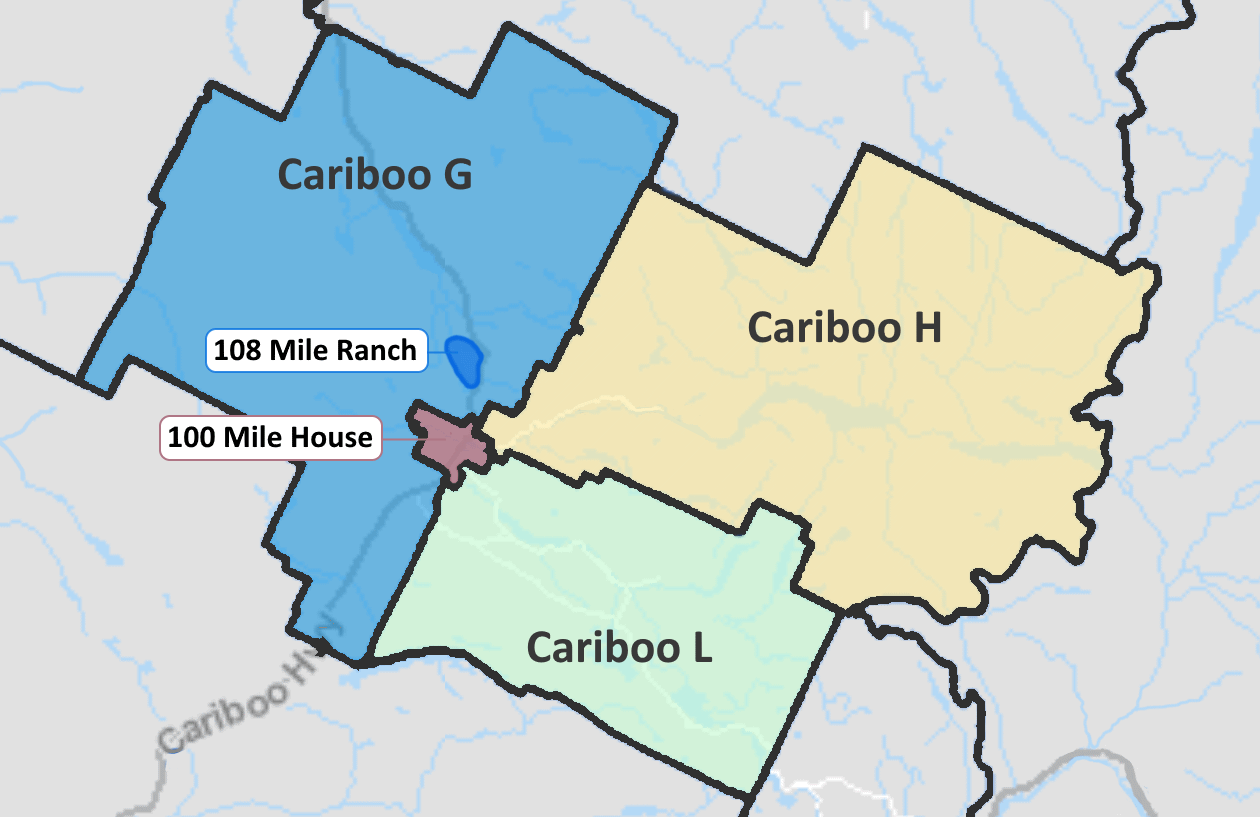
In total, the 100 Mile House area had a combined population of 13,893 people according to the 2021 census data. Of that population, the municipality of 100 Mile House itself had a population of 1,928, while 108 Mile Ranch (which includes the 105 Mile Lake area) had a population of 2,597.
Put simply, 108 Mile Ranch represents about 20% of the population of the entire 100 Mile House area.
In a scenario where 108 Mile Ranch burned up in a wildfire, this would be devastating not only for the people that live in 108 Mile Ranch, but also for the town of 100 Mile House.
Many people that the town of 100 Mile House depends upon would be displaced, including doctors and other healthcare workers, teachers, police officers, utility workers, store employees, etc.
In addition, such an event would also mean a reduction in revenues at stores in 100 Mile House by up to 20%, as the population of 108 Mile Ranch would no longer be visiting businesses in 100 Mile House and spending money there, for the duration of time that they would be displaced, which could be several years or more.
From this point of view, 108 Mile Ranch represents an integral part of the larger 100 Mile House area, and it is in the interest of the District of 100 Mile House for 108 Mile Ranch to not be burned up by wildfire, as it would be a devastating loss for the municipality.
Therefore, because it would be in the municipality's interest, there should be some level of cooperation and ideally even funding provided, in mutual self-interest, for 100 Mile House to support the protection of 108 Mile Ranch. Given the size and population density of 108 Mile Ranch, investment in preventative measures for 108 Mile Ranch would be among the most cost-effective uses of resources to mitigate wildfire risk.
Case Study: Destruction of Lytton BC, July 2021
In 2021, Lytton BC was ravaged by wildfire. When combined with federal contributions, more than $239 million in public funding has been committed to the wider region for recovery.
As of July 2025, a few houses have been rebuilt, but Lytton is still without the town hall, the food mart, the bar, the motel, the hospital and the bank. Only one business has been rebuilt, the Chinese History Museum.
Hundreds of millions of dollars, and four and half years later, and the small community of Lytton has not been rebuilt. It is important to therefore recognize that in the event of a catastrophic wildfire, even with support from the provincial government and the federal government, a community ravaged by wildfire will likely remain badly damaged for many years, and might never return to the way it was before. In that time, many residents may move on and established new lives elsewhere without any intention on returning in the future.
Back to the question raised earlier: would it be worth investing up to a few million dollars to protect hundreds of millions of dollars worth of property and the livelihood of thousands of residents in 108 Mile Ranch?
About this website
This website is not an official website of any sort and is not formally endorsed by any institutions or organizations in 108 Mile Ranch or elsewhere.
This website was created by a resident of 108 Mile Ranch that is concerned about the risk of wildfire and aims to provide a preliminary overview with organized information that may eventually be useful in the creation of a formalized plan of action for the community.
More information-gathering and organizing is still needed. When this document is more fully developed, the next step will be to connect with other community members and eventually the fire department to get more input and build a consensus, to eventually begin real action.